

Research shows that horses form selective, stable social bonds with familiar companions, including unrelated individuals. Proximity, mutual grooming, and coordinated movement indicate affiliation, while these relationships can support stress regulation, reproductive success, and foal survival.
Social isolation, single housing, and separation from bonded companions can cause distress and measurable immune and physiological changes. The findings support consistent companionship and social contact as important elements of horse welfare, rather than optional management benefits.
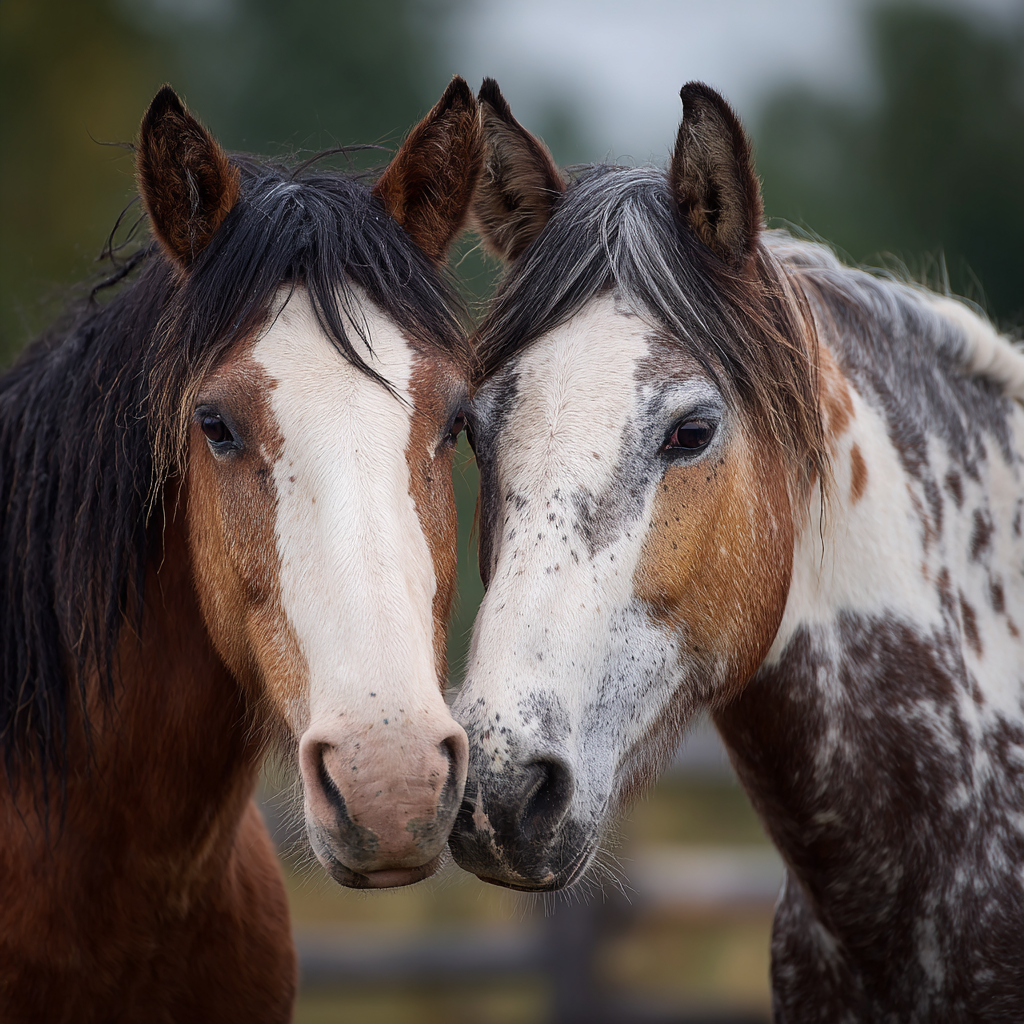
Anyone who has watched one horse pace the fence line while its companion is worked, or seen two horses seek each other out in a large paddock day after day when every other option is available, already has an intuition about the answer. Horses choose certain individuals. They return to them consistently. They are calmer with them nearby and more distressed when they are absent.
Whether that constitutes friendship in any meaningful sense is a question that animal behaviorists have been grappling with for decades, and the answer the research supports is more interesting, more nuanced, and more welfare-relevant than most horse owners realize. The short version is yes, horses form genuine and lasting social bonds. The longer version explains what those bonds actually do, why they matter, and what it costs a horse when they are disrupted or denied altogether.
The Structure of Horse Society: Not Just a Pecking Order
The dominant framework most horse owners learn for thinking about equine social organization is the hierarchy. There is an alpha, there is a bottom horse, and everyone else falls somewhere in between. This model captures something real: agonistic relationships do exist and dominance does influence resource access and spatial positioning. But it misses most of what is actually going on socially.
Feral horses live in multi-tiered societies. At the smallest level is the band, typically comprising one or two adult males, several females, and immature offspring. Multiple bands share foraging areas, follow similar seasonal movements, and maintain complex inter-band relationships. Drone-based research published in Scientific Reports documented this multilevel social organization more precisely than ground-based studies allowed, showing that what appears from the ground to be simple herd behavior is in fact a layered set of stable social relationships operating simultaneously at different scales. The study found that large mixed-sex units occupied the center of the herd structure, while smaller units and all-male groups remained on the periphery, a spatial arrangement reflecting the social architecture rather than chance.1
Within these bands, affiliative relationships are not randomly distributed. Horses develop strong preferences for specific individuals, and these preferences are expressed through proximity, mutual grooming, and coordinated movement. Critically, bonds regularly form between unrelated animals. A 2021 study of feral horse groups in northern Portugal found that familiar individuals spent significantly more time in proximity and groomed each other more often than unfamiliar dyads, but that genetic relatedness did not predict affiliation. Horses were building bonds through familiarity and shared experience rather than kinship.2
The practical significance of this became clear in a landmark study published in the Proceedings of the National Academy of Sciences, which presented four years of behavioral data from feral mares. Social integration between unrelated females increased both foal birth rates and foal survival independently of maternal habitat quality, social group type, dominance status, and age. Socially integrated mares also experienced less harassment from males. The researchers concluded that social bonds in horses can evolve based on their direct fitness benefits alone, without requiring kinship as a foundation.3 In plain terms: having a friend makes a female horse more likely to successfully raise a foal. The bond is not merely emotionally meaningful. It is biologically productive.
What Grooming Actually Does
Mutual grooming, known formally as allogrooming, is the most visible expression of equine social bonding and one of the most studied. Two horses stand head to tail or side by side, using their lips and teeth to scratch areas that are difficult to reach independently, typically along the crest, withers, and back. It looks pleasant, and research confirms that it is, while also serving a deeper social function.
A 2023 study published in Animals examined allogrooming behavior in two large, socially stable herds of domestic mares totaling 200 animals, coding videos for frequency, duration, partner preference, and lateralization across both low-stress pasture conditions and higher-stress confined conditions. The results showed that horses maintained consistent partner preferences across both contexts: the horse another horse chose to groom under low-stress conditions was the same horse they sought out when stressed. Allogrooming frequency increased significantly under stressful conditions, suggesting that horses actively use their bonded companions as a coping resource during periods of elevated tension.4
Research observing 145 feral horses, including five groups of Przewalski’s horses and six groups of feral domestic horses, found that mutual grooming, combined with friendly approaches and spatial proximity data, provided the most reliable indicators of genuine pair bonds. Fifteen hours of behavioral observation per group was sufficient to generate robust bond data, and the study found that these behavioral markers reliably identified bonded pairs across different breeds, group sizes, and social ranks.5 The study also confirmed that mutual grooming has measurable cardiovascular effects: it is accompanied by reduced heart rate, indicating genuine parasympathetic activation rather than simply displacement activity.
One important implication for horse management: when horses are housed in a way that prevents mutual grooming, whether through individual stabling, inadequate social contact, or housing arrangements that permit visual but not tactile contact, they lose access to one of their primary physiological stress-regulation tools. That is not simply a question of preference. It has real physiological consequences.
What Isolation Actually Costs
The welfare literature on equine social isolation is substantial and consistent in its direction, and it makes for uncomfortable reading when set alongside the reality of how many domestic horses are actually managed.
A study published in PLOS ONE investigated the immunological consequences of two different social stressors in horses: changes in group composition, and relocation to individual stabling. Blood immune cell populations and cortisol concentrations were measured before and after each condition. Relocation to single housing produced significant and persistent immune changes, including decreases in eosinophils, T helper cells, and cytotoxic T cells of up to 31%, 20%, and 22% respectively, alongside a 25% increase in neutrophils. The neutrophil-to-lymphocyte ratio, a well-established indicator of stress-induced immune modulation, increased significantly after single housing but not after changes in group composition. Transient cortisol elevations and disturbed behavior patterns accompanied the immune changes in the single-housed horses.6
What this means practically is that individual stabling does not simply affect a horse emotionally. It suppresses the immune system in ways that are both measurable and potentially clinically significant. The horses that changed group composition showed a different immune response pattern, suggesting that the simple loss of social contact, rather than the disruption of specific bonds, was the primary driver of the negative immune effects in the individually stabled group.
Research into what is now being formally defined as separation anxiety in horses has clarified how far-reaching bond disruption can be. An open-access 2026 consensus paper published in Applied Animal Behaviour Science, developed by an international panel of equine behavior specialists, noted that separation from an individual to whom a horse is particularly bonded may result in distress that goes beyond a general response to isolation, potentially representing the loss of an attachment figure.7 The paper identified eight distinct contexts in which separation anxiety may manifest, ranging from preparation for departure through active leaving through the loss of contact itself. Signs associated with this state include increased locomotion, hypervigilance, vocalization, snorting, defecation, and in some cases the opposite pattern of apparent apathy.
For horse owners managing a horse that becomes difficult to separate from a companion, this research reframes the situation. The behavior is not stubbornness, bad manners, or a training gap that more pressure will fix. It is the expression of a neurologically grounded social bond, functioning in exactly the way it evolved to function, now activated in a context where the human management situation conflicts with the horse’s social architecture.
What This Means for How We Keep Horses
The social bond research collectively points in a direction that challenges some deeply ingrained assumptions in horse management, particularly the assumption that individual stabling with controlled paddock turnout is an acceptable baseline for most horses.
Horses are not solitary animals who tolerate social contact. They are social animals whose physiology, immune function, stress regulation, and reproductive success are all measurably influenced by the quality of their social relationships. A horse that lives without meaningful social bonds is not simply less happy in some vague qualitative sense. It is physiologically different from a horse that has them: more immunologically compromised, more chronically stressed, and less equipped to regulate its own arousal.
For practical management, consistent companionship matters more than frequent rotation of social partners. Horses form bonds through familiarity and shared experience, so housing arrangements that frequently disrupt established groups impose a recurring social cost that does not diminish just because the horse eventually adapts to each new configuration.8 The individual stabling model, still standard in many competition and training yards, warrants genuine scrutiny when set against a body of research showing that single housing produces measurable immune suppression.9
When circumstances require housing arrangements that limit direct social contact, research on human social buffering suggests that familiar human company can partially mitigate some stress responses in horses. A 2025 study published in Animal Cognition assessed the buffering effect of a passive human stranger on horses placed in an unfamiliar environment. Cortisol levels increased in both the social and isolation conditions, but heart rate followed a different pattern: after an initial elevation, heart rate decreased significantly in the social condition as interaction with the human increased, falling lower than in the isolation condition. The researchers concluded that human presence provides meaningful social input, but that the cortisol data suggests this does not fully substitute for conspecific social contact.10
The horse watching the gate for its companion is not a management problem to be trained away. It is a social animal doing exactly what its neurology and evolutionary history have equipped it to do, in a management environment that is asking it to live in a way that cuts against its fundamental nature.
The Takeaway
Horses form genuine social bonds. Those bonds are selective, stable, and consequential. They influence reproduction in feral populations, immune function in domestic ones, and moment-to-moment stress regulation in any horse in any setting. The horse that prefers certain companions, that is distressed by separation, and that calms most effectively in the presence of specific individuals is not exhibiting a behavioral quirk or a training deficit. It is expressing a sophisticated social cognition that is central to what horses are.
Understanding this changes how we think about management decisions that disrupt or prevent those bonds. It also changes how we interpret a range of difficult behaviors that are commonly framed as problems requiring correction. Often they are problems requiring a different question: not “how do I stop this horse doing this” but “what social need is this behavior expressing, and am I meeting it?”
The horse at the fence line is telling you something. The research gives us the vocabulary to understand what.
References
- Tamao Maeda et al., “Aerial Drone Observations Identified a Multilevel Society in Feral Horses,” Scientific Reports 11 (2021): 71, https://doi.org/10.1038/s41598-020-79790-1. Full text: https://pmc.ncbi.nlm.nih.gov/articles/PMC7794487/. ↩︎
- Renata S. Mendonça et al., “Social Determinants of Affiliation and Cohesion in a Population of Feral Horses,” Applied Animal Behaviour Science 245 (2021): 105496, https://doi.org/10.1016/j.applanim.2021.105496. Note: paywalled at the publisher; abstract freely available on ScienceDirect. Full findings summarised in open-access citing literature including https://pmc.ncbi.nlm.nih.gov/articles/PMC10177386/. ↩︎
- Elissa Z. Cameron, Trine H. Setsaas, and Wayne L. Linklater, “Social Bonds between Unrelated Females Increase Reproductive Success in Feral Horses,” Proceedings of the National Academy of Sciences 106, no. 33 (2009): 13850–13853, https://doi.org/10.1073/pnas.0900639106. Full text: https://pmc.ncbi.nlm.nih.gov/articles/PMC2728983/. ↩︎
- Emily Kieson, Amira A. Goma, and Medhat Radi, “Tend and Befriend in Horses: Partner Preferences, Lateralization, and Contextualization of Allogrooming in Two Socially Stable Herds of Quarter Horse Mares,” Animals 13, no. 2 (2023): 225, https://doi.org/10.3390/ani13020225. Full text: https://pmc.ncbi.nlm.nih.gov/articles/PMC9854972/. ↩︎
- Riccarda Wolter, Volker Stefanski, and Konstanze Krueger, “Parameters for the Analysis of Social Bonds in Horses,” Animals 8, no. 11 (2018): 191, https://doi.org/10.3390/ani8110191. Full text: https://pmc.ncbi.nlm.nih.gov/articles/PMC6262610/. ↩︎
- Sonja Schmucker et al., “Single Housing but Not Changes in Group Composition Causes Stress-Related Immunomodulations in Horses,” PLOS ONE 17, no. 8 (2022): e0272445, https://doi.org/10.1371/journal.pone.0272445. Full text: https://pmc.ncbi.nlm.nih.gov/articles/PMC9385002/. ↩︎
- Claire Ricci-Bonot et al., “Development of a Consensus Definition of ‘Separation Anxiety’ for Horses,” Applied Animal Behaviour Science 298 (2026): 106937, https://doi.org/10.1016/j.applanim.2026.106937. Open access Creative Commons license. ↩︎
- Ibid Renata ↩︎
- Ibid Sonja ↩︎
- Alfredo Di Lucrezia et al., “The Power of Interspecific Sociality: How Humans Provide Social Buffering for Horses,” Animal Cognition 28 (2025): 20, https://doi.org/10.1007/s10071-025-01942-5. Full text: https://pmc.ncbi.nlm.nih.gov/articles/PMC11903558/. ↩︎