

TLDR – Hoof balance plays a central role in equine soundness because it affects how weight and movement forces are distributed through the limb. Research supports scheduling trimming or shoeing every four to six weeks, with shorter intervals sometimes needed, to limit progressive changes that can increase injury risk.
Owners can support hoof health by regularly checking hoof-pastern alignment, heel height, toe length, flares, cracks, and white line separation. Recording specific changes in movement or hoof condition and sharing them with the farrier and veterinarian helps identify problems and coordinate care.
There is an old saying in the horse world: no hoof, no horse. It sounds like a cliché until you have watched a horse come back from a lameness issue, or stood next to your farrier trying to understand what they are seeing and saying, and realized you don’t quite have the vocabulary to follow along.
Hoof care is one of those areas where the gap between what horse owners know and what they need to know tends to be widest, and where the consequences of that gap are most direct. Research consistently identifies lameness as the most frequently owner-reported health and welfare problem in horses, with hoof and leg issues reported in more than a third of horses in recent population surveys.1 At the same time, a substantial proportion of hoof problems go unreported or unaddressed, meaning the horse is carrying a problem the owner either hasn’t recognised or hasn’t acted on.
This isn’t a gap that reflects negligence. It reflects the fact that hoof care is a genuinely complex discipline, and that the information available to owners varies enormously in quality and consistency. This post is an attempt to give you enough grounding in the basics that you can be a more informed and more effective partner in your horse’s hoof health.
Why Hoof Balance Matters More Than Most People Realise
When your farrier talks about hoof balance, they are talking about something with measurable, documented consequences for your horse’s soundness and long-term health.
The hoof exists to transfer your horse’s bodyweight to the ground while protecting the soft internal structures such as the distal phalanx, the navicular bone, the deep digital flexor tendon, and a network of suspensory ligaments, from the forces generated with every step. A hoof that is out of balance disrupts how those forces are distributed through the limb, and over time, uneven loading leads to uneven wear, uneven stress on internal structures, and increased lameness risk.
A 2024 study published in Animals examined 73 adult horses across show jumping, dressage, and riding school activities, measuring the dorsal hoof wall angle and coronet band circumference of all four feet in relation to observed lameness. Horses with either a very upright foot or a broken-back hoof-pastern axis had higher probabilities of lameness. The researchers concluded that an aligned hoof-pastern axis, managed by a dorsal hoof wall angle of around 50 degrees, may help prevent lameness, and that regular podiatric interventions should be scheduled to maintain correct hoof conformation.2 The study also found that show jumping and dressage horses showed a higher prevalence of lameness overall, suggesting that performance demands amplify the consequences of conformational imbalance.
What this means in practical terms is that the angle and alignment of your horse’s hoof at any given point is not simply an aesthetic consideration. It is a biomechanical one with direct welfare implications. A hoof that drifts out of balance over a long shoeing interval is a hoof that is placing increasing stress on structures that were not designed to bear that load.
How Long Is Too Long Between Visits
The answer most experienced horsekeepers give is four to six weeks, and the research supports this with confidence.
A study published in Animals by researchers at Hartpury College investigated how hoof conformation measurements changed across a four to six week shoeing and trimming interval in working riding school horses. Seventeen different measurements were taken from lateral and anterior photographs before and after farriery. Most lateral view variables changed significantly across the interval. The dorsal hoof wall, weight-bearing length, and coronary band length all reduced after trimming, increasing the vertical orientation of the hoof and improving dorsopalmar alignment. The dorsal hoof wall angle, heel angle, and heel height all increased toward more correct values immediately after farriery and degraded progressively across the interval. The researchers concluded that a regular farriery interval of no more than six weeks could prevent excess loading of the structures within the hoof, reducing long-term injury risks through cumulative excessive loading.3
Six weeks is the outer limit for most horses in regular work, not a comfortable average. Some horses, particularly those with known hoof balance issues, those in heavy work, or those in conditions that accelerate hoof growth, will benefit from a shorter cycle. Others, especially unshod horses on abrasive terrain that promotes natural wear, may be able to extend slightly. The right interval for your horse is a conversation to have with your farrier based on how that individual horse’s foot actually behaves between visits.
What the research makes clear is that the cost of going too long is not cosmetic. The structures inside the hoof are accumulating uneven stress across every day beyond the point where balance has broken down. By the time you can see that a foot is overdue, the biomechanical compensation has already been happening for a while.
What to Look for Between Visits
One of the most useful things a horse owner can do is develop the habit of looking at their horse’s feet regularly and with some intentionality. You don’t need to be a farrier to notice meaningful changes, and noticing them early is where you contribute most to your horse’s hoof health.
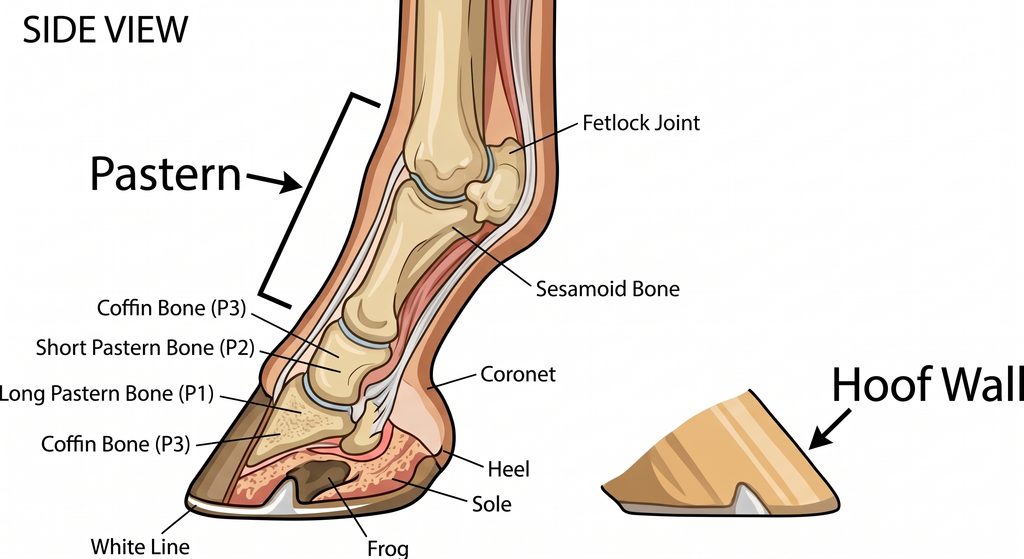
The hoof-pastern axis is one of the simplest things to check from a standing position. When you look at your horse from the side, the slope of the pastern and the slope of the front of the hoof wall should form a continuous, unbroken line. A broken-back axis, where the hoof is more upright than the pastern, or a broken-forward axis, where the toe has grown long and the heel is underrun, are both indicators that the foot is moving out of balance.
Heel height and toe length both change across the shoeing interval. The Lesniak study found that dorsal hoof wall angle, heel angle, and heel height all degrade progressively between farriery visits, and that these changes are measurable well before they become visible to the untrained eye.4 Heels that look crushed or underrun, or a toe that has migrated forward, are signs that balance has already shifted significantly.
Flares on the hoof wall, areas where the wall bends outward rather than growing straight down, indicate mediolateral imbalance. Mild flaring is not unusual but pronounced or worsening flares in the same location suggest an underlying loading pattern your farrier should know about.
Cracks, chips, and white line separation are worth monitoring and reporting. Small surface cracks in dry conditions are often minor, but cracks that track upward toward the coronet band, cracks that appear to move or widen, or any sign of white line disease, a fungal and bacterial infection of the white line zone, should be flagged promptly rather than watched to see if they resolve on their own.
Building a Better Relationship with Your Farrier
Good hoof care is a collaborative effort, and the owner’s role in that collaboration is not passive. Your farrier sees your horse’s feet every four to six weeks for perhaps an hour. You see those feet every day. That gives you access to information your farrier genuinely needs: changes in how the horse is landing on a particular foot, subtle shifts in how they carry themselves, new chips or cracks that appeared two weeks into the interval, or signs of moisture changes in the environment that are affecting hoof quality.
Coming to a farrier appointment with specific observations rather than general concerns makes those conversations considerably more productive. Rather than “he’s been a bit off,” try to describe what you noticed: which foot, at what gait, on what surface, and when in the shoeing interval it appeared. That kind of specific observation gives a farrier something concrete to work with and is often the piece of information that unlocks a diagnosis they might otherwise miss.
The Mata 2024 study reinforced a practical point the farriery literature has made for some time: hoof morphometry should be routinely monitored, and the relationship between owners, farriers, and veterinarians in discussing shoeing options and solutions to foot problems is central to maintaining horse soundness and hoof quality over time.5 When a soundness issue requires both veterinary diagnosis and a farriery response, facilitating communication between those two professionals, rather than managing each relationship separately, produces better outcomes. Knowing your farrier’s name and being comfortable making introductions when needed is a small thing that matters considerably when the situation requires it.
The Bottom Line
Good farriery is one of the most direct investments you can make in your horse’s long-term soundness and wellbeing, and it is one of the areas where owner understanding most clearly translates into better outcomes. Hoof balance is not a cosmetic concern. Regular visits are not optional maintenance. The relationship between your horse’s feet and their ability to move, perform, and live comfortably over a long life is as direct as any connection in equine health.
You don’t need to become an expert. You need to be observant, consistent, communicative, and willing to ask questions. The farrier standing at your horse’s feet has a body of knowledge and skill that most owners will never fully access, and they are most effective when the owner standing beside them is genuinely engaged in the conversation.
References
- Wendy Leah Watson, Jill R. D. MacKay, and Cathy M. Dwyer, “Healthy as a Horse? Characterising the UK and Ireland’s Horse Owners, Their Horses, and Owner-Reported Health and Behavioural Issues,” Animals 15, no. 3 (2025): 397, https://doi.org/10.3390/ani15030397. Full text: https://www.mdpi.com/2076-2615/15/3/397. ↩︎
- Fernando Mata et al., “Investigating Associations between Horse Hoof Conformation and Presence of Lameness,” Animals 14, no. 18 (2024): 2697, https://doi.org/10.3390/ani14182697. Full text: https://pmc.ncbi.nlm.nih.gov/articles/PMC11444133/. ↩︎
- Kirsty Leśniak et al., “Does a 4–6 Week Shoeing Interval Promote Optimal Foot Balance in the Working Equine?” Animals 7, no. 4 (2017): 29, https://doi.org/10.3390/ani7040029. Full text: https://pmc.ncbi.nlm.nih.gov/articles/PMC5406674/. ↩︎
- Ibid Leśniak ↩︎
- Ibid Mata ↩︎