

Horses often suppress visible signs of pain, making discomfort difficult to recognize and frequently underdiagnosed. Validated tools such as the Horse Grimace Scale, Equine Pain Face, and EquiFACS identify facial changes associated with pain, although human observers, including experienced horse handlers, may miss subtle signals.
Research into automated facial-recognition systems shows promise for continuous monitoring but remains under development. Owners can improve detection by learning validated facial cues, maintaining baseline photos or videos, and treating unexplained changes in behavior or performance as possible signs of pain.
There is a problem at the center of horse welfare that most owners understand intuitively but rarely think about in clinical terms. Horses evolved as prey animals in a world where showing weakness invited predation. Their default response to pain, particularly pain that is not immediately disabling, is to suppress the outward signs of it. They keep moving. They keep eating if they can. They tolerate things that would register as obvious distress in a dog or a cat, and they do this not out of bravery in any conscious sense, but because millions of years of evolution selected against visibly injured animals surviving long enough to reproduce.
The welfare consequence of this evolutionary legacy is that horses have historically been dramatically underdiagnosed for pain. Not because owners do not care, but because the signals are subtle, the horse is actively working to conceal them, and until recently, veterinary medicine lacked precise, validated tools for reading those signals systematically. That has changed. Over the last decade, researchers have developed standardized pain assessment protocols based on facial expressions, validated them across multiple painful conditions, and begun extending them into machine learning systems capable of detecting pain in real time. Understanding the science behind these tools belongs in every horse owner’s toolkit.
Why Horses Are So Hard to Read
Before discussing what the research has found, it is worth understanding why pain recognition in horses is genuinely difficult, not simply a matter of paying closer attention.
Research has documented that hospitalized horses with confirmed pain decrease their discomfort behaviors during caretaker visits, meaning that live evaluations can systematically underestimate the severity of pain precisely when a trained observer is present to evaluate it. A study published in Animals observed that in-person caretaker visits disrupted ongoing discomfort behavior in equine orthopedic surgical patients, with horses showing measurably less pain-related behavior the moment a person entered the space.¹ The same suppression applies in ridden work. A horse’s learned compliance can override behavioral expressions that would otherwise flag a problem to an attentive handler, meaning the most trained and most valued horses are often best placed to hide their suffering.¹
Individual variation complicates the picture further. Some breeds and individual horses are more expressive than others, and the range of what a horse in pain looks like is wide enough that no single behavioral signature reliably indicates discomfort across all horses and all contexts. A systematic review and meta-analysis of equine acute pain assessment scales published in Applied Animal Behaviour Science in 2026 confirmed that while acute and severe pain may elicit pronounced behavioral responses, more chronic or nuanced pain requires the observer to detect far subtler changes, and that the evolved tendency of horses to mask discomfort means live evaluations frequently underestimate pain severity.² These are the conditions that motivated researchers to develop something more systematic.
The Horse Grimace Scale and the Equine Pain Face
The systematic use of facial expressions as a pain assessment tool in non-human animals began with a mouse grimace scale developed in 2010, which demonstrated that specific facial action units changed reliably in response to pain across multiple pain models. The concept was rapidly extended to other species, and in horses two landmark papers appeared within a year of each other that established the foundation for equine facial pain assessment.
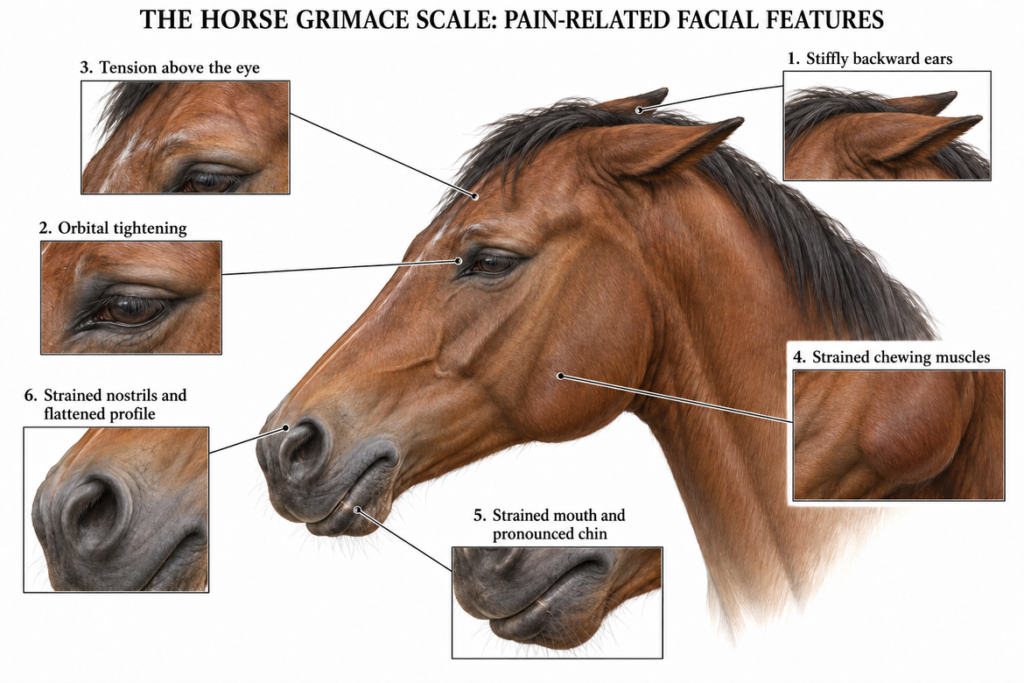
The Horse Grimace Scale, published in PLOS ONE in 2014 by Dalla Costa and colleagues, was developed and validated using 40 stallions undergoing routine surgical castration. The scale identified six facial action units that changed reliably in response to post-surgical pain: stiffly backwards ears, orbital tightening, tension above the eye area, prominent strained chewing muscles, mouth strained and pronounced chin, and strained nostrils and flattening of the profile.³ Each unit is scored as absent, moderately present, or obviously present, giving a numerical score used to estimate pain severity. The scale has since been applied across multiple painful conditions including acute laminitis, dental pain, and colic in subsequent research.
The Equine Pain Face, published in Veterinary Anaesthesia and Analgesia in 2015 by Gleerup and colleagues, used a controlled crossover design in which pain was induced experimentally using a tourniquet and topical capsaicin application on six adult horses. The study identified an equine pain face comprising low and/or asymmetrical ears, an angled appearance of the eyes, a withdrawn and tense stare, mediolaterally dilated nostrils, and tension of the lips, chin, and certain facial muscles.⁴ The horses showed these signs during pain sessions and not during control sessions, demonstrating that the facial configuration was specifically associated with pain rather than being a general stress response.
A subsequent study published in PLOS ONE in 2020 used the Equine Facial Action Coding System to analyze pain-related facial responses in video recordings of horses experiencing experimental and spontaneous pain. The researchers identified that the most prevalent facial action units in painful horses were chin raiser, nostril dilator, half blink, inner brow raiser, eye white increase, and ear rotator.⁵ Critically, the EquiFACS analysis confirmed that these facial changes occurred in the same anatomical regions identified by both the Horse Grimace Scale and the Equine Pain Face protocol, demonstrating convergent validity across three different methodologies developed by independent research groups.
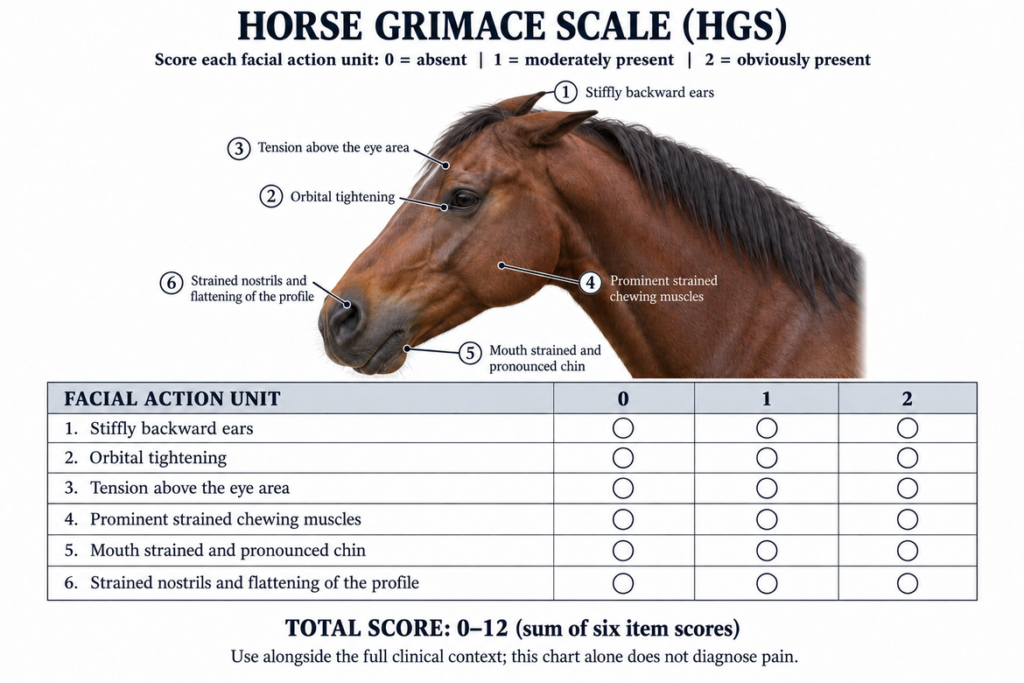
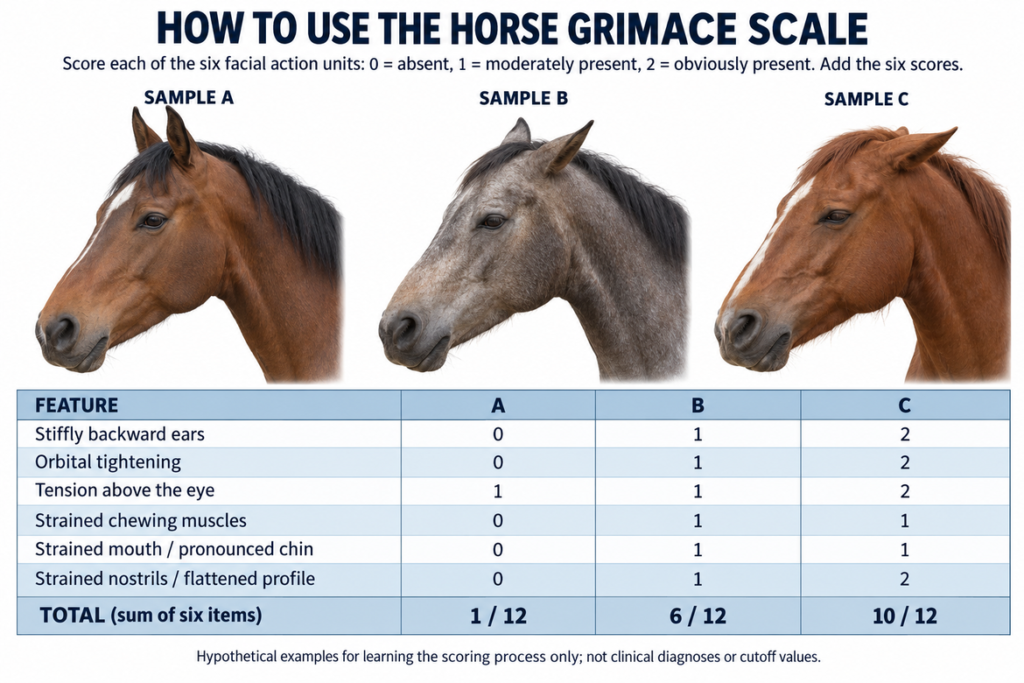
The Horse Grimace Scale is freely available online with illustrated guides and can be learned by owners as well as veterinarians. Research has shown, however, that 30 minutes of face-to-face training may not be sufficient for observers without horse experience to apply it reliably. A case study published in Animals found that a 30-minute standardized training program improved agreement among inexperienced observers but results suggested this level of training represents a starting point rather than a complete preparation.⁶
Who Can Actually Read It: The Human Gap
Even with validated tools available, one of the most striking findings in recent equine pain research concerns how accurately humans detect pain in horse faces, and the answer is not reassuring.
A 2026 study published in Anthrozoös recruited 100 participants ranging from those with no horse experience to seasoned equestrians, with ten equine behavior professionals serving as an expert baseline. Participants rated photographs of both human faces and horse faces for the presence of pain. Overall, accuracy was significantly higher for human faces than for horse faces. Years of horse experience specifically predicted pain recognition accuracy in a linear relationship, but empathy, which many people assume would translate into sensitivity to animal pain, was not related to accuracy for either human or horse faces.⁷ Even experienced participants performed considerably below the expert baseline.
The practical implication is direct. The intuitive assumption that caring about horses translates into reading their pain accurately is not supported by the data. Experience matters but is not sufficient on its own. What matters is calibrated experience combined with knowledge of what specifically to look for, and that knowledge is teachable.
Where the Research Is Going: AI and Continuous Monitoring
The limitations of human pain detection, particularly the fact that even trained observers can only assess a horse at the moment of observation and that horses behave differently when a person is present, have driven a parallel research effort into automated machine learning systems for equine pain detection.
A 2021 study published in PLOS ONE developed and evaluated a machine vision algorithm based on the Horse Grimace Scale, trained using video recordings of horses before and after castration. The system used deep learning methods to classify pain states from facial images automatically. When discriminating simply between pain present and pain absent, the model achieved a success rate of 88.3%, demonstrating proof of concept for automated real-time monitoring.⁸ A camera-based system does not require a human observer to be present, which means the horse’s natural behavior, including the suppressed pain signals that disappear in human company, remains visible for the system to analyze.
A 2024 study published in PLOS ONE developed AI models to automatically recognize emotional states in horses from facial expressions using both deep learning applied to video footage and machine learning applied to EquiFACS annotations. The models showed variable performance across different facial regions, with orbital tightening achieving an F1 score of 0.86 and ear position achieving 0.72 in binary pain classification.⁹ These figures indicate that automated systems are improving meaningfully but have not yet reached the reliability needed for widespread clinical deployment without human verification alongside them.
The direction of travel is clear. Within the coming decade, continuous automated monitoring of horse facial expressions for pain indicators is likely to become practically deployable in stable environments. This would represent a significant welfare advance, enabling detection of pain at its earliest onset rather than at the point where it has become severe enough to change a horse’s performance or behavior in ways obvious enough to be noticed.
What This Means for Horse Owners Right Now
The research does not require horse owners to wait for AI systems or to become certified pain assessment experts. It does suggest a practical shift in how pain recognition is approached day to day.
Learning the validated facial action units associated with equine pain is genuinely useful and increasingly accessible. The Horse Grimace Scale is freely available online with illustrated guides. The six action units it describes, ear position, orbital tightening, tension above the eye, quality of the eye’s gaze, nostril appearance, and lip and chin tension, are observable in any horse at any time, and developing fluency in reading them improves with deliberate practice rather than simply time spent around horses.
Maintaining a photographic or video baseline of your horse’s neutral face is a practical tool most owners do not use but would benefit from. A horse’s resting facial expression, recorded when they are genuinely comfortable and pain-free, gives you a reference point for comparison on days when something seems off but you cannot quite identify what has changed.
Treating unexplained behavior changes as potential pain signals before assuming training or management problems is perhaps the most consequential shift the research supports. A horse that was settled and is now reactive, that resists the girth after months of compliance, that loses condition without a dietary explanation, or that seems dull in ways that do not map onto any obvious stressor is a horse communicating something. The equine pain face research gives that communication a language worth learning.
The Takeaway
Horses evolved to hide pain. For most of the history of horse-keeping, that meant significant suffering went undetected because the animals being hurt were least likely to advertise it. The research reviewed in this post represents a systematic scientific effort to close that gap: to give veterinarians, researchers, and ultimately horse owners validated tools to see past the evolutionary mask and recognize what is actually happening.
The Horse Grimace Scale, the Equine Pain Face protocol, the EquiFACS pain action units, and the AI systems emerging from that foundational research are all part of the same project. They are making equine pain legible in ways it has never been before, and the welfare implications are significant for every horse in every barn.
Knowing what a horse in pain looks like is not specialist knowledge. It is basic horsemanship for the twenty-first century.
References
¹ Catherine Torcivia and Sue M. McDonnell, “In-Person Caretaker Visits Disrupt Ongoing Discomfort Behavior in Hospitalized Equine Orthopedic Surgical Patients,” Animals 10, no. 2 (2020): 210, https://doi.org/10.3390/ani10020210. Full text: https://pmc.ncbi.nlm.nih.gov/articles/PMC7070977/.
² Federica Raspa et al., “Horse Acute Pain Assessment Scales and Key Parameters: A Systematic Review and Meta-Analysis,” Applied Animal Behaviour Science 300 (2026): 107006, https://doi.org/10.1016/j.applanim.2026.107006. Open repository full text: https://iris.unito.it/retrieve/c9754f31-329a-4629-9f46-e3cbfc48361f/25-2026.%20Raspa-Muca%20et%20al.%20Horse%20acute%20pain%20assessment.pdf.
³ Emanuela Dalla Costa et al., “Development of the Horse Grimace Scale (HGS) as a Pain Assessment Tool in Horses Undergoing Routine Castration,” PLOS ONE 9, no. 3 (2014): e92281, https://doi.org/10.1371/journal.pone.0092281. Full text: https://journals.plos.org/plosone/article?id=10.1371/journal.pone.0092281.
⁴ Karina B. Gleerup et al., “An Equine Pain Face,” Veterinary Anaesthesia and Analgesia 42, no. 1 (2015): 103–114, https://doi.org/10.1111/vaa.12212. Full text: https://pmc.ncbi.nlm.nih.gov/articles/PMC4312484/.
⁵ Mohammed Rashid et al., “Equine Facial Action Coding System for Determination of Pain-Related Facial Responses in Videos of Horses,” PLOS ONE 15, no. 11 (2020): e0231608, https://doi.org/10.1371/journal.pone.0231608. Full text: https://journals.plos.org/plosone/article?id=10.1371/journal.pone.0231608.
⁶ Francesca Dai et al., “Does Thirty-Minute Standardised Training Improve the Inter-Observer Reliability of the Horse Grimace Scale (HGS)? A Case Study,” Animals 10, no. 5 (2020): 781, https://doi.org/10.3390/ani10050781. Full text: https://pmc.ncbi.nlm.nih.gov/articles/PMC7277819/.
⁷ Nicola J. Gregory et al., “Reading Pain in Horse and Human Faces: The Influence of Horse Experience, Social Anxiety, and Empathy,” Anthrozoös 39, no. 1 (2026): 161, https://doi.org/10.1080/08927936.2025.2551433. Open access: https://www.tandfonline.com/doi/full/10.1080/08927936.2025.2551433.
⁸ Gabriel Carreira Lencioni et al., “Pain Assessment in Horses Using Automatic Facial Expression Recognition Through Deep Learning-Based Modeling,” PLOS ONE 16, no. 10 (2021): e0258672, https://doi.org/10.1371/journal.pone.0258672. Full text: https://pmc.ncbi.nlm.nih.gov/articles/PMC8525760/.
⁹ Marcelo Feighelstein et al., “Automated Recognition of Emotional States of Horses from Facial Expressions,” PLOS ONE 19, no. 7 (2024): e0302893, https://doi.org/10.1371/journal.pone.0302893. Full text: https://pmc.ncbi.nlm.nih.gov/articles/PMC11249218/.