

Equine dental disease is widespread, age-related, and more complex than routine annual floating suggests. Research cited in the post links oral problems to chewing difficulty, weight loss, and some behavior changes, while emphasizing that these effects are often multifactorial.
The post argues for regular professional mouth exams with proper equipment, especially in younger and older horses. It also notes that floating supports welfare but does not reliably produce immediate performance improvements, and that over-treatment can cause harm.
There is a version of horse dentistry that most owners understand at a basic level: the teeth need floating once a year, sharp points cause discomfort, and a horse that is dropping feed or losing weight needs its mouth checked. That is a reasonable foundation. It is also only part of the picture.
The equine mouth is one of the most anatomically complex and dynamically changing systems in the horse’s body, and dental disease is considerably more prevalent, more varied, and more consequential than the standard floating narrative suggests. Research is increasingly documenting connections between oral health and a range of issues that are frequently investigated everywhere except the mouth first: unexplained weight loss, training resistance, back tension, and subtler behavioral changes that accumulate slowly enough that owners do not notice until something is significantly wrong.
This post does not claim that floating fixes everything, because the evidence does not support that either. What it does is give you a more complete picture of what is actually happening in your horse’s mouth across their lifetime, and why paying closer attention to it matters more than most owners currently do.
How Common Dental Disease Actually Is
Before discussing what dental problems cause, it is worth establishing just how common they are. The answer, across multiple population studies, is strikingly prevalent.
A 2022 study published in Animals conducted routine veterinary dental examinations on 206 privately owned horses in the Mazovia region of Poland and found that 95% of examined horses presented with a dental disorder in at least one tooth. Malocclusions were more prevalent than dental disease across incisors, premolars, and molars alike, with curvatures and dental calculus among the most commonly recorded findings.¹ This was not a population of neglected horses. These were privately owned animals in regular management, and the near-universal prevalence of some form of dental abnormality should shift how we think about the baseline.
A retrospective study examining dental records from 932 horses seen by a first-opinion practice in south-western England and southern Wales over one year found that active periodontal disease was present in 13.9% of horses, diastemata in 8.7%, and peripheral caries in 8.2%. Increasing age was a significant risk factor for both periodontal disease and diastemata, and a strong positive association was found between periodontal disease and diastemata, suggesting that these conditions tend to occur together rather than independently.² These are not exotic or rare conditions. They are findings documented across general equine practice populations, in proportions that make routine examination genuinely important rather than merely good practice.
An earlier cross-sectional survey of horses examined at a processing facility in Western Canada found that the most common oral pathologies included sharp edges, buccal abrasions, calculus, lingual ulcers, gingival recession, periodontal pockets, ramps, and waves. Several types of pathology were strongly associated with other dental disorders, and the prevalence of periodontal pockets, gingival recession, and wave mouth was highest in older horses.³ The pattern across all three studies is consistent: dental disease is widespread, it clusters with other dental abnormalities, and it becomes more severe and more complex with age.
The practical implication is that an annual examination by a qualified professional using a full-mouth speculum and adequate lighting is the minimum that the prevalence data supports, not a conservative recommendation. For horses under five years, where the mouth is undergoing rapid and significant change as deciduous teeth are shed and permanent teeth erupt, examination every six months reflects the pace of change rather than excessive caution.
What Dental Problems Actually Affect
The connection between dental health and body condition is the one most owners know about, and it is real but often overstated as a standalone mechanism. The research presents a more nuanced picture.
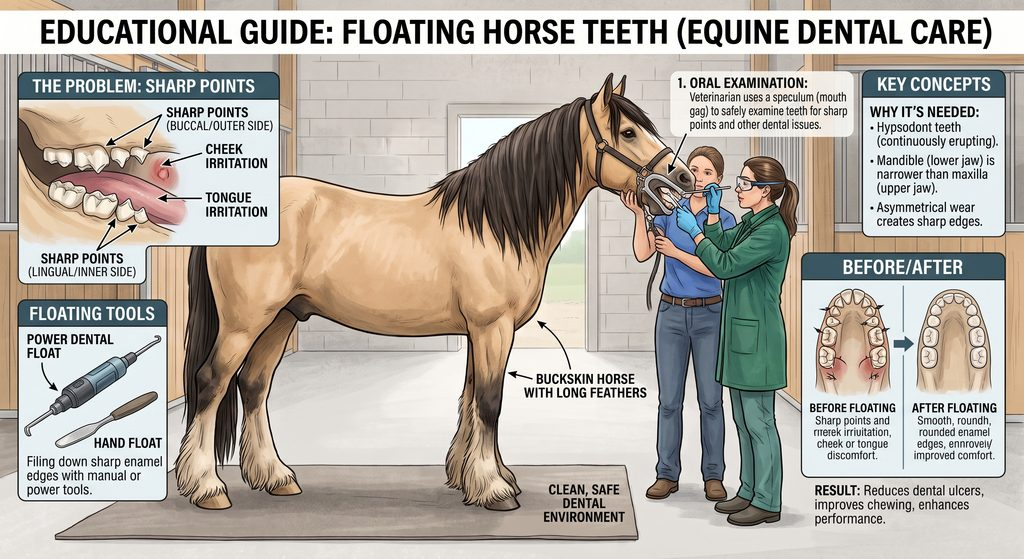
Sharp enamel points on the cheek teeth lacerate the soft tissue of the cheeks and tongue, causing pain during mastication. When chewing is painful, horses modify how they move their jaws, may chew less thoroughly, drop food in the process known as quidding, and in some cases reduce feed intake overall. Inadequately chewed food passes through the digestive tract with reduced surface area available for enzymatic digestion, leading to poorer feed utilization. This pathway from dental abnormality to reduced body condition is well-established in principle, though a careful evidence-based review of the literature notes that research shows dental malocclusions minimally impact weight loss in horses with otherwise adequate nutrition, and that nutritional changes may be more significant drivers of weight loss than dental abnormalities in most cases.⁴ The honest summary is that dental disease contributes to weight loss and reduced feed efficiency, particularly in older horses with more complex abnormalities, but it is rarely the sole or primary cause in horses with access to adequate and appropriate feed.
Where behavioral and performance effects are concerned, the connection is documented across clinical observation but harder to quantify in controlled research. What we know from the biomechanics is this: when the lower jaw slides forward during poll flexion, anything that obstructs that movement mechanically limits the horse’s ability to flex at the poll. Hooks on the upper cheek teeth, which develop when the upper and lower arcades do not align correctly, can interfere with the normal rostrocaudal mobility of the mandible in ways that become directly relevant under saddle when a rider applies contact. The design, position, and size of the bit influence oral comfort, and a mouth that is already sensitive from sharp points or periodontal disease is a mouth that is poorly positioned to tolerate bit pressure comfortably.⁴
A 2025 paper published in Animals comparing rein tensions reported in the scientific literature against human pressure pain thresholds provides context that is difficult to ignore. Reported rein tensions in the literature ranged widely, and the comparison against the human pressure pain detection threshold for the face of 232 kilopascals led the authors to conclude that bit pressures as reported in the scientific literature would likely induce strong pain sensations in humans, raising significant welfare concerns about ridden horses.⁵ This context matters for dental health because it means a horse’s mouth is already being exposed to substantial mechanical force during ridden work, and any source of existing oral pain or sensitivity compounds the experience.
What the Evidence Says About Floating and Performance
One of the more interesting and somewhat counterintuitive findings in equine dental research concerns performance dentistry, the practice of equilibrating the occlusal surface of the teeth specifically to improve rideability and performance rather than simply to address pain and welfare.
A randomised, blinded, controlled trial published in Veterinary Quarterly examined 38 Franches-Montagnes stallions, all given a dental malocclusion score by a veterinary dentist before being randomised to either sham treatment or performance dentistry including occlusal equilibration. A professional dressage rider assessed rideability using a 27-point scale. There was no correlation between dental malocclusion score and rideability score prior to treatment, no difference in rideability score between treatment groups after treatment, and no interaction of treatment group with time.⁶
An earlier study by Carmalt, Carmalt, and Barber, published in the Journal of Veterinary Dentistry, similarly found no statistically significant improvement in the dressage test score of horses that had received occlusal equilibration when horses were re-evaluated 48 hours after treatment.⁶
The interpretation of these findings is not that dental care does not matter, but that the relationship between dental health and ridden performance is not as direct and measurable as proponents of performance dentistry have claimed, and that the expectation of immediate performance improvement after floating may be unrealistic. What the evidence does support is that dental examination and treatment is necessary for welfare, for pain management, and for maintaining the conditions under which a horse can function comfortably. That is sufficient justification in itself without requiring the additional claim that it directly improves dressage scores.
This is also a place where it is worth noting the importance of who performs dental work on your horse. Evidence-based reviews of equine dentistry emphasise that most dental procedures are performed without critical evaluation of their actual benefits or outcomes, and that thorough oral examination every six to twelve months is what the evidence most robustly supports.⁴ Over-floating, aggressive reduction of tooth material, and poorly performed equilibration can cause as much harm as the dental problems they purport to treat. The emphasis should be on comprehensive examination by a qualified practitioner, not on the quantity of material removed.
Recognising Problems Between Examinations
Professional examinations are the foundation, but horses spend most of their time with their owners rather than their veterinarians, and the observations owners make between appointments are often what flags a problem early enough to address it before it becomes complex.
The most recognisable signs of dental discomfort are quidding, which is the dropping of partially chewed balls of hay or grass, and slow or one-sided chewing. Both indicate that the normal mastication process has been disrupted, either because of pain, occlusal abnormality, or inadequate grinding surface. Weight loss that does not respond to increased feed quantity, or undigested grain or long hay fibers in the manure, can both suggest that feed is passing through without adequate processing at the chewing stage.
Behavioral signs specific to ridden work are subtler but worth knowing. One-sided resistance to contact, consistent head tilting or tossing, reluctance to accept the bit on one side, stiffness through the poll and jaw during work, and tension in the temporal and masseter muscles are all worth noting and reporting to your veterinarian. None of these signs definitively indicates a dental problem, but all of them warrant adding dental examination to the differential investigation rather than defaulting to a training response.
Foul breath, nasal discharge on one side, facial swelling around the cheeks or jaw, or blood in the mouth are signs that warrant prompt veterinary attention as they suggest infection, abscess, or more severe dental pathology that needs diagnosis and treatment rather than monitoring.
Senior horses, generally those over fifteen years, deserve particular mention because the pattern of dental disease changes significantly with age. The periodontal disease and diastemata documented as more prevalent in older horses are conditions that can become progressively painful and require management approaches different from those appropriate for middle-aged horses.² The goal in older horses shifts from maintaining a perfect mouth toward maintaining comfortable function, and the feeding management considerations change accordingly. Older horses with missing teeth, significant periodontal disease, or significantly reduced dental reserve may need softer feed forms, shorter hay, or soaked alternatives to maintain adequate nutrition while keeping eating comfortable.
The Bottom Line
The equine mouth is not simply a mechanical feed processor that needs occasional maintenance. It is a complex, age-sensitive, pathology-prone structure that influences digestion, behavior, comfort under tack, and welfare in ways that are well-documented even if they are not always as linear as owners sometimes assume.
Dental disease is near-universal in horses examined carefully enough for it to be found. Regular examination, by a qualified professional using appropriate equipment and sedation, is the only reliable way to know what is happening in a horse’s mouth at any given time. The frequency appropriate for any individual horse depends on their age, history, and what previous examinations have found, but annual examination is the floor rather than the ideal for most adult horses.
The other thing the evidence supports is a degree of humility about what we expect floating to fix. Addressing dental pain and maintaining oral health are goals that need no further justification. Expecting immediate performance transformation is a higher bar than the controlled research currently clears. Both things can be true, and accepting both makes for clearer thinking about equine dental care and better outcomes for the horses in our care.
References
¹ Kamil Górski et al., “Malocclusions and Dental Diseases in Privately Owned Horses in the Mazovia Region of Poland,” Animals 12, no. 22 (2022): 3120, https://doi.org/10.3390/ani12223120. Full text: https://pmc.ncbi.nlm.nih.gov/articles/PMC9686654/.
² H.E. Nuttall and P.J. Ravenhill, “Prevalence and Analysis of Equine Periodontal Disease, Diastemata and Peripheral Caries in a First-Opinion Horse Population in the UK,” Veterinary Journal 246 (2019): 98–102, https://doi.org/10.1016/j.tvjl.2019.02.005. Note: paywalled at the publisher; abstract and statistics confirmed via PubMed PMID 30902197; available through institutional access.
³ James Anthony et al., “A Survey of Equine Oral Pathology,” Journal of Veterinary Dentistry 27, no. 1 (2010): 12–15, https://doi.org/10.1177/089875641002700102. Note: paywalled at the publisher; findings confirmed via PubMed PMID 20469790; available through institutional access.
⁴ James L. Carmalt, “Evidence-Based Equine Dentistry: Preventive Medicine,” Veterinary Clinics of North America: Equine Practice 23, no. 2 (2007): 519–524, https://doi.org/10.1016/j.cveq.2007.03.002. Note: paywalled at the publisher; available through institutional access.
⁵ Frauke Musial and Thomas Weiss, “What if Horses Were Humans? Comparing Rein Tension and Bit Pressures to Human Pressure Pain Thresholds,” Animals 15, no. 20 (2025): 2989, https://doi.org/10.3390/ani15202989. Full text: https://pmc.ncbi.nlm.nih.gov/articles/PMC12560900/.
⁶ Sébastien Moine et al., “Evaluation of the Effects of Performance Dentistry on Equine Rideability: A Randomized, Blinded, Controlled Trial,” Veterinary Quarterly 37, no. 1 (2017): 195–199, https://doi.org/10.1080/01652176.2017.1329598. Full text: https://www.tandfonline.com/doi/full/10.1080/01652176.2017.1329598.